
Project Profile · Test Equipment & Process Control Software
Automated Vacuum Leak Test System: Replacing an HMI Touch Panel with Clear, Step-by-Step Status
High Tech Services (HTSI) built the vacuum leak test hardware, then hired Qualtx Technology to replace its small HMI touch panel with a Windows PC-based control system. The result is a 5-step automated leak test that shows an operator exactly what's happening — and whether it passed or failed — at every step, line by line. The finished system is now in use by Lockheed Martin.
Project Overview
The Automated Vacuum Leak Test System runs a 5-step sequence that evacuates a sealed test chamber, backfills it with process gas, and measures how much the pressure rises over a fixed window of time to determine whether a part has a leak. High Tech Services (HTSI) built and supplied the vacuum chamber, pump, gas valves, and sensor hardware, and hired Qualtx Technology to design the control software that sequences the test and reports results to the operator.
Qualtx Technology handled the complete software side of the project: PLC I/O integration, the step sequencing logic, and a Windows PC-based operator interface that replaced the original HMI touch panel with a full-screen, step-by-step status display.
The Requirement
The original leak test machine ran on a small HMI touch panel. It could only show a limited amount of information on screen at once, so operators had a hard time telling exactly where the test was in its 5-step sequence, or why it had stopped. HTSI wanted a system that was easier to use and gave a much clearer status layout — one that let the operator see, at a glance, exactly which step the test was on, whether that step had passed or failed, and what to do next if it hadn't.
System Architecture
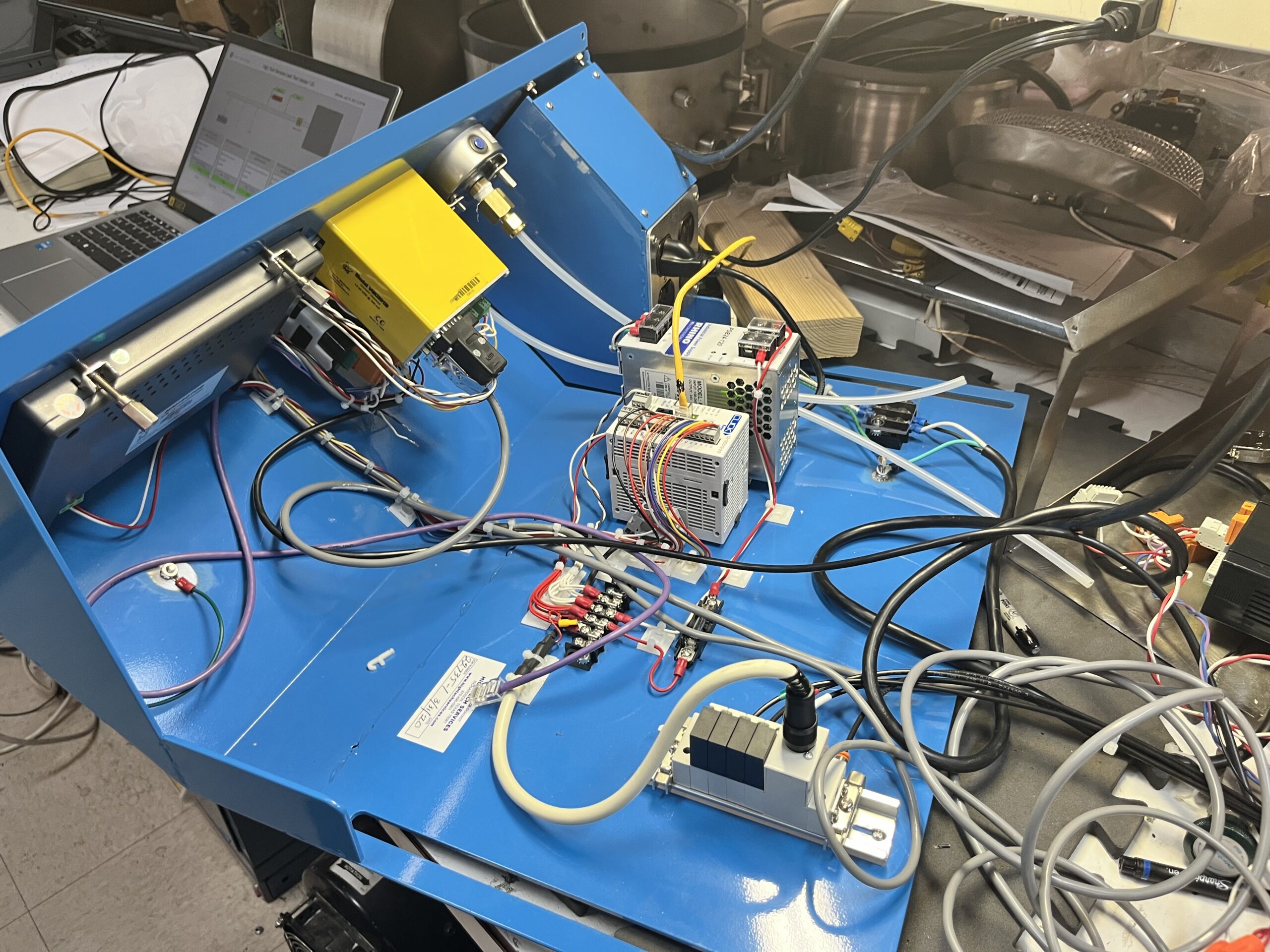
Qualtx Technology built the replacement around a PLC handling real-time I/O and a Windows PC running the operator-facing control software:
| Component | Specification |
|---|---|
| Controller | Click PLC handling all real-time sensor inputs and valve/pump outputs |
| Operator Interface | Windows PC running Qualtx Technology's custom control and status-display software, replacing the original small HMI touch panel |
| Sensing | Vacuum sensor and pressure sensor, 24 VDC digital inputs to the PLC |
| Process Control Outputs | Pump, nitrogen (N2) backfill valve, and helium/nitrogen (He/N2) backfill valve, each a 24 VDC digital output |
| Test Chamber Hardware | Vacuum chamber, rough pump, manual valve, and gas supply lines — built and supplied by HTSI |
| Sequence | 5 operator-visible steps, each independently pass/fail gated — the system halts and waits for operator intervention on any failure |
How the 5-Step Leak Test Works
Each step must complete and pass before the system moves on to the next. A failure at any point halts the sequence immediately and marks that step as failed on screen, rather than continuing on with a bad part:
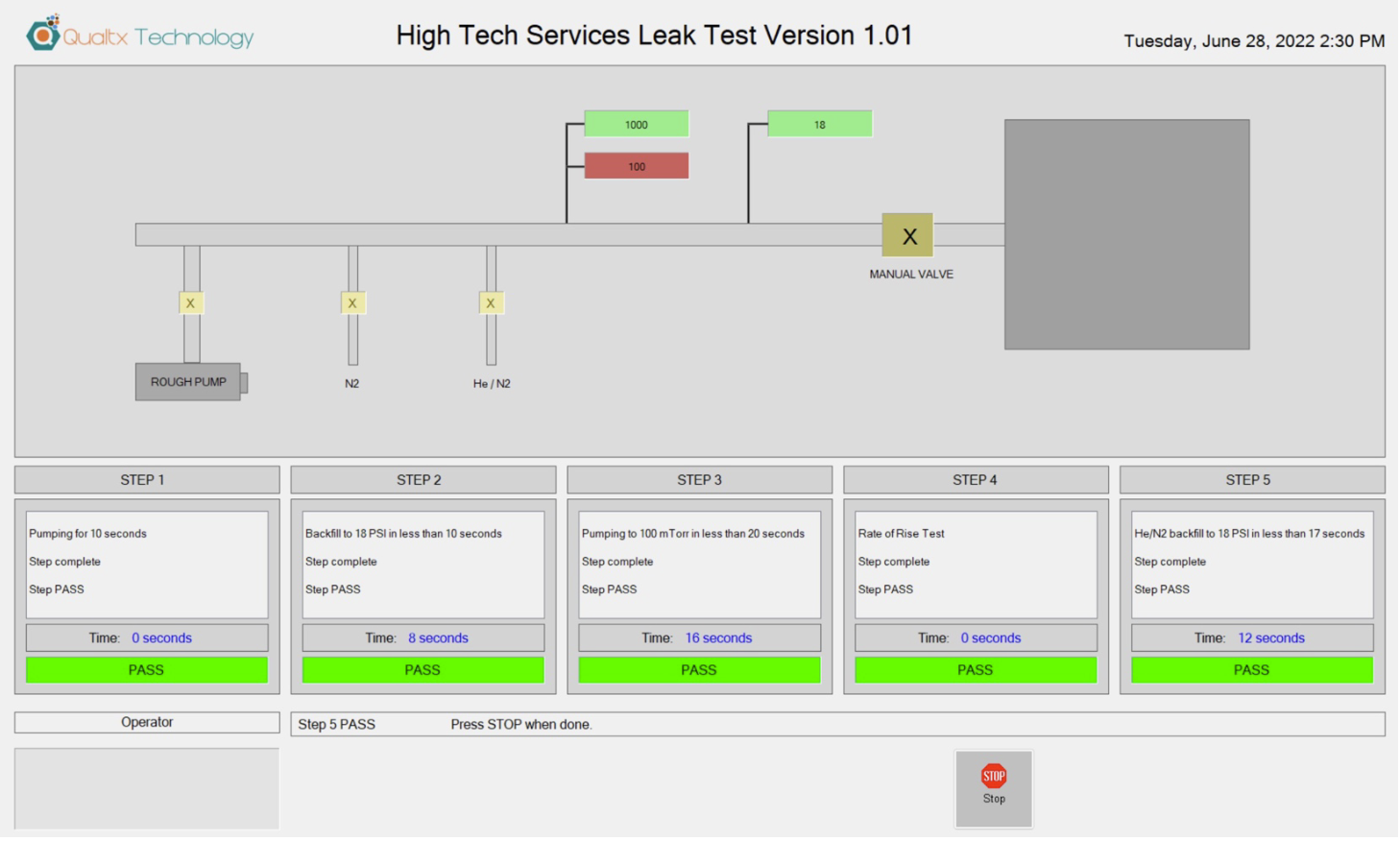
- Step 1 — First Evacuation: The pump runs to draw the chamber down. This step also checks for a valve fault: if the chamber reaches vacuum too quickly, that indicates the isolation valve didn't actually open and the reading is false, so the step fails rather than passing on bad data.
- Step 2 — Nitrogen Backfill: The nitrogen backfill valve opens and pressurizes the chamber to 18 PSI, confirmed by a pressure switch input, verifying the backfill path is working correctly.
- Step 3 — Second Evacuation (Gross Leak Check): The chamber is re-evacuated down to 100 millitorr within a set time limit. Reaching that vacuum level within the window confirms there's no gross leak in the part.
- Step 4 — Rate-of-Rise Test: The chamber is isolated from the pump and monitored for a fixed window of time. If pressure rises no higher than 1000 millitorr in that window, the part passes — this is the actual fine-leak measurement at the heart of the test.
- Step 5 — Final Backfill: The helium/nitrogen backfill valve opens and returns the chamber to 18 PSI, so the part can be safely removed once testing is complete.
Because every step is checked independently, a bad part gets caught at the earliest possible step instead of running through the entire test cycle first — and the operator always knows exactly which step stopped the process and why.
Operator Interface
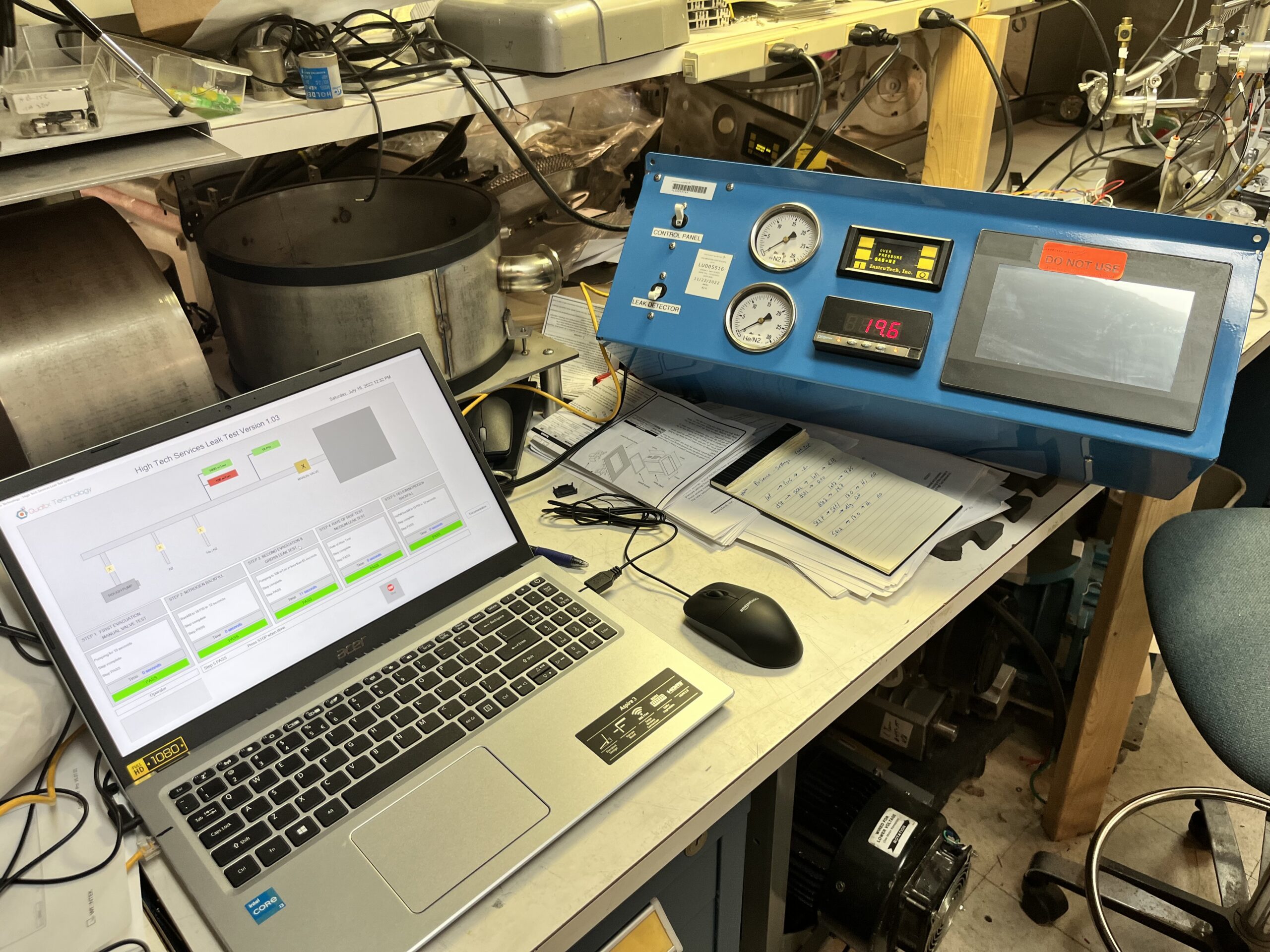
The heart of the project was giving the operator a much clearer picture of what the machine is doing. Instead of a small touch panel showing one thing at a time, the Qualtx Technology software lays out all 5 steps side by side on a full PC screen, along with a live schematic of the vacuum/gas system:
Why It Matters
- Operators can see the entire 5-step test at a glance instead of hunting through screens on a small touch panel.
- Each step reports its own pass/fail result and elapsed time, so troubleshooting a failed part starts with knowing exactly which step and why.
- The system halts on the first failed step rather than running a bad part through the full cycle, saving test time and gas.
- A built-in fault check during the first evacuation catches a stuck or unopened valve before it produces a misleading vacuum reading.
- HTSI's customer, Lockheed Martin, now runs a leak test process that's easier to operate and easier to trust.
Scope of Work
Qualtx Technology delivered the complete control software package for the leak test system:
- PLC I/O integration for vacuum and pressure sensing, pump control, and gas backfill valves
- 5-step sequencing logic with independent pass/fail gating at every step
- Windows PC-based operator interface with live process schematic and step-by-step status display
- Replacement of the original HMI touch panel with the new PC-based control system
- On-site software development, debug, and commissioning alongside the existing leak test hardware
- Ongoing complimentary software updates and bug fixes for the post-installation support period
About Qualtx Technology
Qualtx Technology has been providing turnkey automated control solutions for the semiconductor and nanotechnology industries since 1997. Over nearly three decades, Qualtx has delivered control systems and retrofits for a wide range of clients, including AMD, the US Navy, NASA's JPL, NIST, MIT, Texas Instruments, Raytheon, Micron Technology, Cornell, Northeastern University, the University of Texas, Lockheed Martin, Microchip, and Leonardo DRS, across process tool types including RIE/RFPECVD, ECR, ion mill, ion implanter, MOCVD, and sputter deposition systems.
Frequently Asked Questions
What does the automated vacuum leak test system do?
It runs a 5-step sequence that evacuates a test chamber, backfills it with nitrogen and helium/nitrogen gas, and measures pressure rise over time to detect leaks in a sealed part. Each step must pass independently before the system moves to the next one; if any step fails, the system stops and waits for an operator to intervene rather than continuing with a bad part.
What are the 5 steps of the leak test process?
Step 1 evacuates the chamber and checks for a valve fault by confirming vacuum isn't reached too quickly. Step 2 backfills with nitrogen to 18 PSI. Step 3 re-evacuates the chamber to 100 millitorr as a gross leak check. Step 4 isolates the chamber and runs a rate-of-rise test, watching that pressure doesn't climb past 1000 millitorr within the test window — the actual fine leak measurement. Step 5 backfills with a helium/nitrogen mix to 18 PSI so the part can be safely removed.
Why did Qualtx Technology replace the original HMI touch panel?
The original small HMI touchscreen could only show limited information at a time, making it hard for operators to tell exactly where the test was in its sequence. Qualtx Technology replaced it with a Windows PC running custom software that displays all 5 steps side by side, each with its own live status, elapsed time, and pass/fail indicator, so an operator can see the entire test at a glance.
What hardware and software run the leak test system?
A Click PLC handles the I/O — reading the vacuum sensor and pressure sensor and driving the pump and the nitrogen and helium/nitrogen backfill valves — while a Windows PC runs Qualtx Technology's custom control and status-display software, communicating with the PLC to sequence the test and show live results on screen.
What happens if the leak test fails at a step?
The system stops immediately at whatever step failed, marks that step as failed on screen, and waits for operator intervention. It does not continue on to later steps with a part that has already failed an earlier check.
Who uses this leak test system?
The leak test hardware was built by High Tech Services (HTSI), which hired Qualtx Technology to design the replacement control software. The finished system is now in use by Lockheed Martin.